Golden Teacher: A Complete Guide
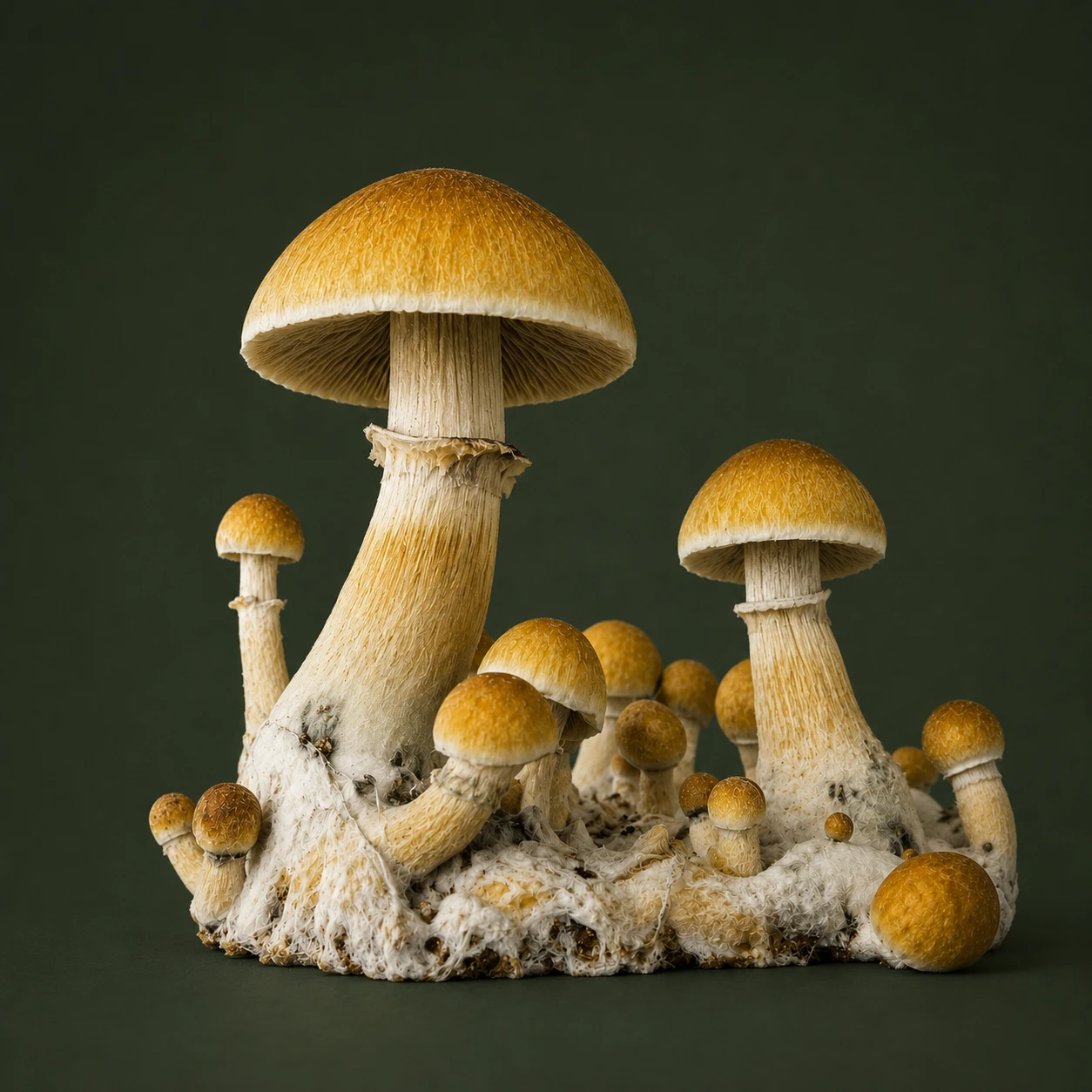
A guide to the history, taxonomy, characteristics and microscopy of a well-known Psilocybe cubensis strain name.
Last updated: 13th October 2026
What Is Golden Teacher?
Golden Teacher is a widely recognised name associated with Psilocybe cubensis, a species of mushroom that has attracted interest from mycologists, researchers and mushroom enthusiasts. The name is commonly used to refer to a particular cultivated type within the species, rather than a separate species in its own right.
The name Golden Teacher has become familiar through its use in mushroom-related communities and online discussions of Psilocybe cubensis. However, although the name is widely recognised, the terminology used to describe named mushroom types is not always consistent.
Understanding Golden Teacher means distinguishing between the name itself, the species it is associated with and the evidence available to support claims about a particular sample.
In biological classification, Psilocybe cubensis is the scientific name of the species. Golden Teacher is an informal name used to distinguish a particular type associated with that species. This distinction is important because a commonly used name does not automatically represent a formally defined taxonomic group.
Golden Teacher is therefore best understood within the broader context of cultivated mushroom varieties and the way these names are used in mycology. The name provides a familiar point of reference, but it should not be taken as proof that every sample carrying the label shares the same genetic background or biological characteristics.
For readers interested in learning more, it is helpful to explore the scientific classification of Psilocybe cubensis and the differences between formal taxonomy and informal variety names.
Buy our Golden Teacher Spores here
Golden Teacher and Psilocybe cubensis
To understand Golden Teacher properly, it helps to know how scientific species names differ from the names commonly used for cultivated mushroom types.
Psilocybe cubensis is a recognised fungal species. Golden Teacher is a commonly used name associated with a cultivated type within that species. Although the two names are related, they do not mean the same thing.
Understanding the species name
Scientific names provide a consistent way to identify organisms across different languages and regions. Psilocybe cubensis belongs to the genus Psilocybe, and its scientific name places it within a formal system of biological classification.
Taxonomy draws on evidence such as physical characteristics, genetic relationships and other biological information to describe and classify organisms. Scientific classifications can change as new evidence becomes available, but they serve a different purpose from the informal names used within mushroom culture.
Golden Teacher, by contrast, is not a separate formally recognised species. It is a name associated with a particular cultivated type of Psilocybe cubensis.
What does a cultivated-variety name mean?
Cultivated mushroom types are often discussed using names that help distinguish them from other types within the same species. These names can become established through repeated use by growers, suppliers and wider mushroom communities.
However, the terminology is not always precise. The words strain, variety and cultivar may be used informally to describe cultivated mushroom types, even though they have different meanings in scientific and horticultural contexts.
In genetics and microbiology, a strain can refer to a distinguishable genetic or biological line. In everyday mushroom-related discussions, the term is sometimes used more loosely for a named type. The label alone does not establish how that type was originally defined or whether its lineage has been independently verified.
For this reason, Golden Teacher is best described in general terms as a commonly used name associated with a cultivated type of Psilocybe cubensis.
Does the name establish genetic identity?
No. A name by itself cannot establish that every sample described as Golden Teacher has an identical genetic background.
Establishing genetic relationships requires appropriate evidence and reliable information about the material being studied. Where a sample’s provenance is uncertain, its name should not be treated as definitive proof of its lineage.
This distinction is useful when reading descriptions of named mushroom varieties online. A familiar label may provide context, but claims about genetic uniformity or a particular lineage need supporting evidence.
What Makes Golden Teacher Distinct?
Golden Teacher is distinctive primarily because it has become a widely recognised name within the culture surrounding Psilocybe cubensis. Like other named mushroom types, it provides a familiar way for people to refer to a particular cultivated variety.
The use of names such as Golden Teacher reflects the way people organise and discuss variation within cultivated fungi. These names can be useful for communication, but their meaning depends on how they are used and how well the identity of the material is documented.
The role of named mushroom varieties
Within mushroom culture, named varieties help people distinguish between types that are discussed or marketed separately. Over time, a name may become familiar through publications, community discussions, product descriptions and other references.
However, the popularity of a name does not necessarily mean that it corresponds to a scientifically established genetic group. Two samples carrying the same name cannot automatically be assumed to be genetically identical, just as differently named samples cannot automatically be assumed to be biologically distinct.
This is an important distinction between naming conventions and scientific evidence.
Why variety names can be difficult to verify
The reliability of a variety name depends partly on the information available about its origin and continued use. If a name is passed between sources without reliable documentation, it can become difficult to determine precisely what it represents.
This does not make informal names useless. They can still provide a convenient way to discuss cultivated types. The important point is to avoid treating the name as stronger evidence than it actually is.
For Golden Teacher, the name is widely recognised, but the label alone does not establish a verified genetic lineage or prove that every sample sold or described under that name has the same characteristics.
Names, appearance and scientific classification
A common name, an organism’s observable characteristics and its scientific classification are three different things.
Common names develop through use and may vary between communities. Physical characteristics can vary within a species and may be influenced by biological and environmental factors. Scientific classification, meanwhile, aims to organise organisms according to biological evidence.
These distinctions matter when interpreting information about Golden Teacher. The name identifies a commonly discussed type associated with Psilocybe cubensis, but it should not be confused with a separate species or treated as conclusive evidence of an individual sample’s identity.
For a closer look at identification-related characteristics and the limitations of visual assessment, read our dedicated Golden Teacher Mushroom Identification guide.
What Do We Know About Golden Teacher?
Golden Teacher is a widely recognised name associated with Psilocybe cubensis, but not every claim about its origins or development is supported by the same level of evidence.
Information about named mushroom varieties is often repeated across websites, forums and online communities. While some accounts may draw on historical records or documented sources, others rely on anecdotal reports that are difficult to verify independently.
It is therefore important to distinguish between the established use of the Golden Teacher name and more specific claims about its origins, original lineage or development. A story that appears frequently online is not necessarily a historically verified account.
For a closer look at the available evidence, commonly repeated origin stories and the history of the name, read our dedicated Golden Teacher History guide.
Golden Teacher at a Glance
The following table summarises the essential facts about Golden Teacher and its relationship with Psilocybe cubensis.
| Feature | Information |
|---|---|
| Common name | Golden Teacher |
| Associated species | Psilocybe cubensis |
| Type of name | Informal cultivated-variety name |
| Separate species? | No |
| Scientific classification | Associated with the species Psilocybe cubensis |
| Genetic identity | The name alone does not establish a verified genetic lineage |
| Main areas of interest | Fungal taxonomy, variety naming and microscopy |
The key distinction is that Psilocybe cubensis is the scientific species name, whereas Golden Teacher is a commonly used name associated with a cultivated type within that species. Understanding this difference helps put descriptions of Golden Teacher into the correct scientific context.
Frequently Asked Questions About Golden Teacher
What is Golden Teacher?
Golden Teacher is a widely recognised name associated with a cultivated type of Psilocybe cubensis. It is an informal variety name, not a separate formally recognised species.
Is Golden Teacher a separate mushroom species?
No. Golden Teacher is a commonly used name associated with Psilocybe cubensis. It is not a separate formally recognised species.
Is Golden Teacher a scientific name?
No. Psilocybe cubensis is the scientific species name. Golden Teacher is an informal name used for a particular cultivated type or line associated with that species.
Is Golden Teacher a type of Psilocybe cubensis?
Yes. The name Golden Teacher is used for a cultivated type associated with Psilocybe cubensis. The scientific name refers to the species, while Golden Teacher is an informal name used to distinguish a particular type within it.
Is Golden Teacher a formally recognised scientific variety?
Golden Teacher is commonly used as a cultivated-variety name, but it is not a separate formally recognised species. Informal naming conventions do not necessarily correspond to formal taxonomic classifications.
Can the Golden Teacher name confirm a sample’s genetic identity?
No. A label alone cannot establish a sample’s genetic lineage or demonstrate that all samples sold under the same name are genetically identical. Such claims require appropriate supporting evidence.
Where can I learn more about Golden Teacher spores?
Our Golden Teacher Spores Under the Microscope guide explores spore morphology and microscopic characteristics in greater detail.
How can I learn more about Golden Teacher identification?
Our Golden Teacher Mushroom Identification guide covers identification-related characteristics and explains why appearance alone has limitations when establishing identity.
Where did Golden Teacher originate?
The name is widely used in discussions of Psilocybe cubensis, but specific claims about its origins should be assessed against the available historical evidence. Our Golden Teacher History guide explores this subject in more detail.
Explore Our Golden Teacher Guides
This guide provides an introduction to Golden Teacher and its relationship with Psilocybe cubensis. If you’d like to explore a particular aspect of the subject in more depth, our specialist guides cover three related topics.
Golden Teacher History
Discover what is known about the origins of the Golden Teacher name, how it became established in mushroom culture, and which historical claims are supported by available evidence.
Read the Golden Teacher History guide →
Golden Teacher Mushroom Identification
Explore identification-related characteristics and the limitations of relying on appearance alone. This guide looks more closely at the challenges of distinguishing named mushroom types.
Read the Golden Teacher Mushroom Identification guide →
Golden Teacher Spores Under the Microscope
Learn about the microscopic study of Golden Teacher-associated spores, including spore morphology and the role of microscopy in examining fungal material.