Golden Teacher Guide
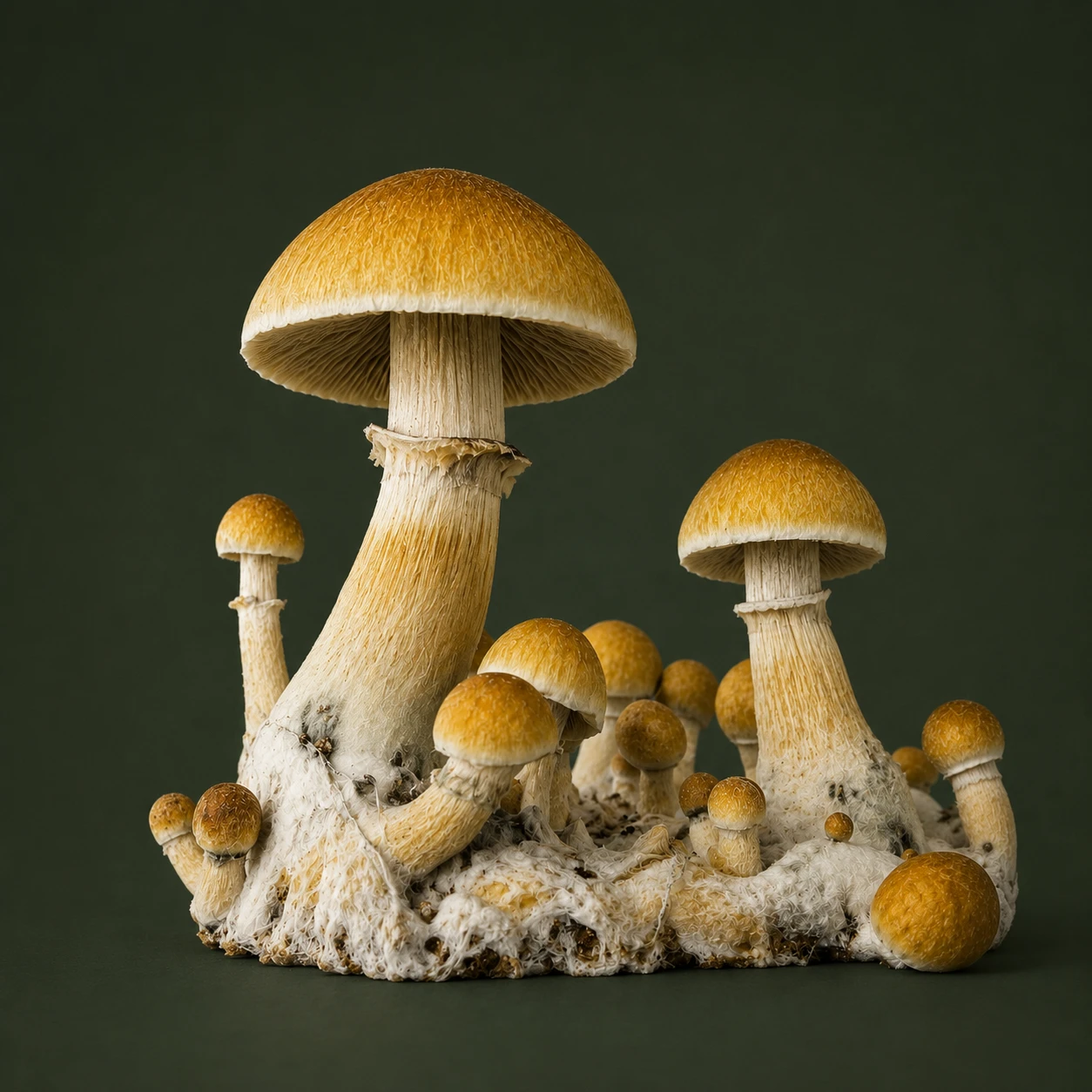
A guide to the history, taxonomy, characteristics and microscopy of a well-known Psilocybe cubensis strain name.
Last updated: 2nd September 2026
TABLE OF CONTENTS
- What Is Golden Teacher?
- Golden Teacher Taxonomy
- History and Background
- Characteristics of Golden Teacher
- Golden Teacher Spores
- Golden Teacher Under the Microscope
- Golden Teacher and Psilocybe cubensis
- Golden Teacher vs Other Cubensis Strains
- Frequently Asked Questions
- Further Reading
What Is Golden Teacher?
Golden Teacher is a commonly used name for a cultivated type or strain associated with Psilocybe cubensis, a species of mushroom in the genus Psilocybe. The name Golden Teacher is not a formal scientific classification and does not represent a separate species.
This distinction is useful when discussing Golden Teacher because the terminology surrounding named mushroom strains can be confusing. Psilocybe cubensis is the scientific species name, while Golden Teacher is a name used to distinguish a particular cultivated line or population within that species.
Golden Teacher and Psilocybe cubensis
Psilocybe cubensis is the formal scientific name of the species with which Golden Teacher is associated. In biological classification, a species name has a defined taxonomic meaning, whereas names such as Golden Teacher are used more informally to identify particular cultivated types.
The relationship can therefore be thought of simply as:
Species: Psilocybe cubensis
Common strain name: Golden Teacher
Golden Teacher should not be treated as a species in its own right. Other commonly encountered names, including B+, Ecuadorian and Mazatapec, are similarly used within the P. cubensis community to distinguish particular cultivated lines.
The scientific name is italicised because it follows the conventions used for biological nomenclature. Psilocybe identifies the genus and cubensis identifies the species.
What Does “Strain” Mean?
The word “strain” is widely used when discussing cultivated mushrooms, but it is not a formal taxonomic rank like genus or species.
In practical usage, a strain generally refers to a particular cultivated lineage, genetic population or selection within a species. A strain name can therefore be useful for distinguishing one cultivated type from another without implying that the organisms involved belong to different species.
This is particularly relevant to Golden Teacher. Describing it as a strain of Psilocybe cubensis communicates that the name refers to a particular cultivated type within the species, rather than suggesting that Golden Teacher has its own separate place in formal taxonomy.
It is also worth remembering that a strain name does not necessarily mean that every specimen carrying that name is genetically identical. Cultivated mushroom populations can contain natural variation, and the history of individual cultures may not always be documented in sufficient detail to establish an unbroken genetic lineage.
Why Are Mushroom Strain Names Sometimes Inconsistent?
Unlike scientific species names, many mushroom strain names have developed through cultivation communities and informal exchange rather than through a centralised system of nomenclature.
As a result, the same name may sometimes be used with different levels of precision. Historical information about a particular strain can also be difficult to verify, particularly where cultures have been exchanged and maintained over many generations.
Golden Teacher is a good example of this distinction between established taxonomy and strain history. There are numerous accounts online describing the origins and history of the Golden Teacher name, but these accounts are not always consistent or supported by primary documentation.
For this reason, it is useful to separate what can be established scientifically from what is commonly reported within the mushroom community.
The species Psilocybe cubensis has a formal taxonomic identity. The history and precise provenance of a particular culture described as Golden Teacher may be considerably less certain.
Is Golden Teacher a Separate Species?
No. Golden Teacher is not a separate species.
The formal species name is Psilocybe cubensis, while Golden Teacher is a commonly used name for a particular cultivated type associated with that species.
This distinction applies to many familiar mushroom names. A named strain can be useful when discussing a particular cultivated population without representing a new species or formal taxonomic category.
Understanding this difference is especially important when interpreting information about mushroom identification. A specimen may be consistent with the characteristics of P. cubensis without it being possible to establish a particular strain name from those characteristics alone.
Golden Teacher and Microscopy
The distinction between species and strain is particularly relevant when examining spores under a microscope.
Microscopy can reveal useful features of fungal material, including characteristics of spores and other structures. These observations can be compared with published descriptions and reference material to help understand the specimen being examined.
However, a strain name such as Golden Teacher should not be regarded as something that can necessarily be confirmed from an individual spore by microscopy alone. Different cultivated types associated with P. cubensis can share many of the same broad microscopic characteristics.
In other words, microscopy can provide valuable information about the material being examined, but the label “Golden Teacher” describes the provenance or identity assigned to a cultivated line rather than a unique microscopic feature.
This is one reason that careful terminology matters when discussing mushroom spores: species identification and strain identification are not necessarily the same thing.
Why Is It Called Golden Teacher?
The exact history of the name is not completely clear.
“Golden” is commonly understood as a reference to the golden coloration associated with descriptions of the mushrooms. Explanations for the word “Teacher”, however, are less certain and are often presented as informal interpretations that have been repeated within the mushroom community.
These explanations should be distinguished from formal scientific information. Unlike Psilocybe cubensis, Golden Teacher is not a scientific name, and there is no equivalent taxonomic definition attached to the words themselves.
What is clear is that the name has become widely recognised as a designation for a particular type of P. cubensis and is now commonly used in discussions of mushroom strains, spores and microscopy.
In Summary
Golden Teacher is best understood as a commonly used strain name associated with Psilocybe cubensis. It is not a separate species or formal taxonomic rank.
The distinction between the species, Psilocybe cubensis, and the strain name, Golden Teacher, helps explain why information about mushroom strains can sometimes be inconsistent and why a strain name cannot necessarily be established through microscopy alone.
For those interested in studying Golden Teacher spores, microscopy provides an opportunity to examine their characteristics in greater detail. Our Golden Teacher spores are available in several formats for lawful microscopy and research purposes.
Golden Teacher Taxonomy
| Classification | Description |
|---|---|
| Kingdom | Fungi |
| Phylum | Basidiomycota |
| Class | Agaricomycetes |
| Order | Agaricales |
| Family | Hymenogastraceae |
| Genus | Psilocybe |
| Species | Psilocybe cubensis |
Before getting into the history of Golden Teacher, it helps to get the terminology straight.
Golden Teacher is not a species.
It is a commonly used name for a particular Psilocybe cubensis lineage or cultivated type. The formal scientific species is Psilocybe cubensis.
The species has a much longer and better-documented taxonomic history. P. cubensis was originally described by Franklin Sumner Earle in 1906 under the name Stropharia cubensis, before subsequently being transferred to the genus Psilocybe. It is now recognised as a species within the genus Psilocybe.
Golden Teacher sits below that formal species classification.
That’s an important distinction because strain names and scientific taxonomy aren’t the same thing. Golden Teacher isn’t a formally recognised species, and the name doesn’t have the same taxonomic status as Psilocybe cubensis.
In other words:
Genus: Psilocybe
Species: Psilocybe cubensis
Common strain name: Golden Teacher
And that’s about as far as we can take the formal taxonomy.
The term “strain” is used extensively in mushroom culture, but it isn’t necessarily a formal taxonomic rank. Names such as Golden Teacher, B+, Amazonian and PE6 are useful for identifying particular lines or types circulated within the mycology community, but the names alone don’t establish a scientifically verified lineage or genetic identity.
That’s where things get interesting.
History and Background
There are lots of repeated claims online about the origin and history of Golden Teacher that aren’t particularly well sourced.
Golden Teacher has a long history. Its exact origin is much less certain.
You’ll find plenty of websites claiming that Golden Teacher first appeared in a particular place, during a particular year, or that it can be traced to a specific wild specimen.
The problem?
There isn’t a strong historical record that allows those claims to be treated as established fact.
Golden Teacher became established through the hobbyist and mushroom-spore communities, particularly during the period when named Psilocybe cubensis varieties began circulating widely outside academic mycology. Modern sources commonly place its emergence somewhere around the 1980s, but the precise provenance remains uncertain.
That makes Golden Teacher quite different from a formally described species with a documented type specimen and collection locality.
Its name is essentially a piece of mycological cultural history.
The “Golden” part is fairly straightforward. It refers to the characteristic warm golden, honey or caramel tones often associated with the caps.
The “Teacher” part is less scientific.
It’s generally understood as an informal name reflecting the strain’s longstanding reputation within mushroom culture. Exactly who coined the name, and precisely why, isn’t particularly well documented.
And that’s something worth being honest about.
There is a difference between a story being repeated for decades and a story being historically verified.
Golden Teacher has certainly been circulating for decades. What can’t be established with the same confidence is a single, definitive origin story.
That uncertainty doesn’t make the strain less interesting.
If anything, it makes the history more interesting.
Characteristics of Golden Teacher
Golden Teacher is particularly recognisable for its classic Psilocybe cubensis appearance.
The caps typically develop through warm yellow, golden-brown and caramel shades. Younger specimens tend to have a more rounded or bell-shaped cap, which can expand and flatten as they mature.
The stems are generally pale or whitish and can be relatively substantial compared with the cap.
The gills begin relatively pale and become progressively darker as the spores mature, eventually taking on the characteristic dark purple-brown appearance associated with mature P. cubensis spore deposits.
These features make Golden Teacher visually distinctive.
But there’s an important caveat.
Appearance alone doesn’t prove strain identity.
Different P. cubensis lineages can overlap considerably in their physical characteristics. Environmental conditions can also influence how an individual specimen looks.
So while a golden cap might look very “Golden Teacher”, you can’t look at a mushroom and scientifically prove that it belongs to the Golden Teacher lineage simply from its appearance.
The same applies to spores.
P. cubensis spores are generally described as smooth, dark purple-brown in mass and broadly ellipsoid to subellipsoid in shape. Published measurements fall within a characteristic range for the species, although individual samples can show variation.
This is one reason microscopy is so useful — but also why it is important not to overstate what microscopy can tell you.
A microscope can reveal fascinating details about the spores and help with species-level observations and comparisons.
It can’t necessarily tell you, on its own, that a particular spore came from “Golden Teacher” rather than another named P. cubensis strain.
And that’s the distinction between observing a specimen and proving its lineage.
Golden Teacher at a glance
| Characteristic | Typical description |
|---|---|
| Species | Psilocybe cubensis |
| Common name | Golden Teacher |
| Taxonomic status | Informal strain/lineage name |
| Cap | Golden to caramel-brown |
| Mature gills | Dark purple-brown |
| Spores | Smooth, broadly ellipsoid/subellipsoid |
| Spore deposit | Dark purple-brown |
| Origin | Uncertain; commonly associated with 1980s-era circulation |
The important takeaway: Golden Teacher is best understood as a well-established community name for material associated with Psilocybe cubensis, rather than as a formally recognised taxonomic entity.
That distinction is easy to overlook — and it’s one of the things that makes the world of mushroom strains much more interesting than a simple list of names.
Golden Teacher Spores
Tiny things. Lots to see.
Golden Teacher produces the same basic type of basidiospore associated with Psilocybe cubensis. In a mature spore deposit, they appear dark purple-brown. Individually, they’re much less dramatic — small, smooth and generally brownish under transmitted light.
The spores are typically ellipsoid to subellipsoid in shape, with a smooth wall and an apical germ pore. Published descriptions of P. cubensis place the spores at roughly 11–17 μm long and 7–12 μm wide, although individual specimens naturally vary.
That’s the basic picture.
But there’s an important distinction to make.
Golden Teacher spores don’t have a secret microscopic fingerprint that separates them from every other cubensis strain.
The characteristics you see under the microscope are primarily characteristics of Psilocybe cubensis itself. Golden Teacher, B+, Amazonian and many other named cubensis varieties can share very similar spore morphology.
And that’s exactly why microscopy is interesting.
You’re looking at the biology behind the name.
Interested in examining Golden Teacher spores?
View our Golden Teacher spore products, available in several formats for lawful microscopy and research.
Golden Teacher Under the Microscope
This is where things get properly tiny.
Under suitable magnification, Golden Teacher spores can be observed as individual, three-dimensional structures rather than the dark mass you see in a spore print.
Look closely and you’ll typically see an ellipsoid or subellipsoid shape. Think oval, but not necessarily a perfect oval.
The walls are smooth rather than ornamented, and a small germ pore can be present at one end of the spore. This is an important feature in the microscopic description of P. cubensis.
The colour is interesting too.
A whole spore deposit appears dark purple-brown because you’re looking at thousands upon thousands of spores together. A single spore viewed through transmitted light is much more subtle.
It isn’t a tiny black dot.
It’s a tiny biological structure with its own shape, wall and internal detail.
What can you observe?
When examining Golden Teacher spores, characteristics of interest include:
- Shape — generally ellipsoid to subellipsoid
- Size — measured in micrometres
- Colour — purple-brown in mass, with individual spores appearing lighter under transmitted light
- Surface — generally smooth
- Germ pore — visible at the apical end
- Variation — individual spores aren’t carbon copies of one another
And this last point matters.
Biology isn’t a production line.
You can expect some natural variation between individual spores and between samples. That’s why serious microscopic observation is about looking at multiple specimens, rather than finding one spore and deciding you’ve solved the mystery.
A useful limitation
Microscopy can tell you a lot about what you’re looking at.
But it can’t necessarily tell you “this is definitely Golden Teacher”.
The spores of different P. cubensis strains overlap heavily in their microscopic characteristics. Spore morphology is therefore much more useful for studying and comparing fungal material than for independently proving a particular commercial strain name.
That’s an important distinction.
The microscope shows you what’s there.
It doesn’t magically reveal the history of the specimen.
Golden Teacher and Psilocybe cubensis
Golden Teacher belongs to Psilocybe cubensis.
That’s the bit to remember.
Psilocybe cubensis is the species. Golden Teacher is a cultivated strain or lineage name used within that species.
So while Golden Teacher has its own name and recognisable appearance, it isn’t a separate species sitting alongside P. cubensis.
Think of it like this:
Genus: Psilocybe
Species: Psilocybe cubensis
Strain name: Golden Teacher
Simple enough.
Things get less simple when you start comparing strains.
Golden Teacher, B+, Amazonian, PE6 and other familiar names are used to distinguish particular lines circulated within the mushroom community. But these names don’t represent formal taxonomic ranks in the same way that genus and species do.
That means there isn’t necessarily a unique microscopic characteristic that says:
“Golden Teacher. Case closed.”
The spores of Golden Teacher generally fit comfortably within the broader morphological description of P. cubensis.
And that’s actually one of the most interesting things about studying them.
The name tells you about the lineage. The microscope shows you the biology.
Those aren’t always the same thing.
Golden Teacher is therefore best understood as a well-established name within the cultivated P. cubensis world, rather than as a scientifically distinct taxonomic entity.
Once you understand that distinction, the whole world of mushroom strains starts to make a lot more sense.
Golden Teacher vs Other Cubensis Strains
Golden Teacher isn’t the only name you’ll encounter when exploring Psilocybe cubensis.
Far from it.
B+. PE6. Amazonian. Purple Mystic. Albino A+. There are dozens of names circulating through the mycology community, and new ones seem to appear all the time.
So what actually makes Golden Teacher different?
The short answer is: mostly the lineage and the name attached to it, rather than a completely different set of microscopic characteristics.
Golden Teacher, B+ and many other named varieties are all associated with the same species: Psilocybe cubensis.
That means their spores share the broad characteristics of the species. They’re generally ellipsoid or subellipsoid, smooth and purple-brown in mass. There can be variation between samples, but you shouldn’t expect a Golden Teacher spore to look dramatically different from a B+ spore under the microscope.
Golden Teacher vs B+
Probably the comparison you’ll see most often.
Both are long-established P. cubensis names, and both have become widely circulated in mushroom culture.
Their mushrooms can have slightly different appearances, but microscopy alone isn’t a reliable way to distinguish the two at strain level.
If someone tells you that they can look at one cubensis spore under a microscope and definitively announce “Golden Teacher” or “B+”, be sceptical.
The microscope can tell you a lot about the specimen.
It can’t tell you its entire family tree.
Golden Teacher vs PE6
PE6 is another familiar P. cubensis name, but its history and naming are different from Golden Teacher.
You’ll often find descriptions of PE6 referring to its relationship with other named cubensis lines. As with many strain histories, however, online accounts aren’t always consistent or independently documented.
For microscopy, the important point is that PE6 is still being discussed within the broader P. cubensis group.
Again, the spores don’t suddenly become a completely different animal.
Golden Teacher vs Albino A+
This is where the visual differences can become more obvious.
Albino A+ is associated with a much paler appearance than the typical golden-brown colouring associated with Golden Teacher.
But even here, appearance isn’t the same thing as taxonomy.
Both names are used within the P. cubensis world, and the microscopic characteristics of their spores remain broadly consistent with the species.
So which one is “best”?
That’s the wrong question.
There isn’t a scientific ranking of P. cubensis strain names.
Golden Teacher isn’t a superior species. B+ isn’t a different species. PE6 isn’t automatically more interesting because its name sounds unusual.
They’re names associated with different cultivated lines and histories.
For microscopy, that makes them useful as comparison material.
Different names. Different histories. Lots of things to investigate.
Frequently Asked Questions
What is Golden Teacher?
Golden Teacher is a commonly used name for a cultivated strain or lineage associated with Psilocybe cubensis. It isn’t a separate species or formal taxonomic rank.
What is the scientific name for Golden Teacher?
Golden Teacher is associated with the species Psilocybe cubensis. There is no formally recognised species called Psilocybe golden teacher.
Are Golden Teacher spores different from other Psilocybe cubensis spores?
Not dramatically. Golden Teacher spores share the broad morphological characteristics of P. cubensis, including their generally ellipsoid shape and purple-brown spore deposit.
Can you identify Golden Teacher spores under a microscope?
Not reliably at strain level.
Microscopy can reveal useful characteristics of the spores, but Golden Teacher and other P. cubensis varieties can have very similar spore morphology. Provenance and other evidence are important when considering strain identity.
What do Golden Teacher spores look like?
They are generally small, smooth and ellipsoid to subellipsoid, with a purple-brown appearance in mass. Individual spores are microscopic and require suitable magnification to examine properly.
Do Golden Teacher spores contain psilocybin?
No. Spores themselves do not contain psilocybin or psilocin.
Why is Golden Teacher called Golden Teacher?
The “Golden” part is generally associated with the characteristic golden-brown appearance of the mushrooms. The origin of the “Teacher” part is less certain and has become part of the informal history surrounding the name.
When was Golden Teacher discovered?
There isn’t a reliably documented single discovery event or universally accepted origin story. Golden Teacher became established through hobbyist mycology and spore communities, but claims about an exact date or geographical origin should be treated cautiously.
Is Golden Teacher a strain or a species?
It’s best described as an informal strain, cultivar or lineage name associated with Psilocybe cubensis. It isn’t a formally recognised species.
What is the difference between Golden Teacher and B+?
Both are names associated with Psilocybe cubensis. They have different histories and can show differences in physical appearance, but their spores share the fundamental microscopic characteristics of the species and cannot reliably be distinguished at strain level by microscopy alone.
What is the difference between a spore print and a spore syringe?
A spore print consists of spores deposited onto a surface, while a spore syringe contains spores suspended in liquid. Both can provide material for microscopy and research.
Are Golden Teacher spores supplied for cultivation?
No. Our spores are supplied for microscopy and research purposes only. We don’t provide cultivation instructions.
Are Golden Teacher spores legal in the UK?
The legal position surrounding Psilocybe material can be complicated and can change, so don’t rely on generic claims that spores are simply “legal”. Customers should check the current law applicable to them and use the material only for lawful purposes.
Further Reading
Still curious? Good. There’s plenty more to look at.
Golden Teacher is only one piece of the Psilocybe cubensis puzzle. We’ve put together more detailed guides if you want to go down the rabbit hole.
Golden Teacher Taxonomy
Species, strain names, taxonomy and the slightly messy history behind one of the world’s best-known cubensis names.
→ Read Golden Teacher Taxonomy
Golden Teacher Spores
A closer look at spores, their characteristics and what you can actually see under the microscope.
Golden Teacher vs B+
Two familiar names. One species. What actually separates them — and what doesn’t?
→ Read the comparison
Psilocybe cubensis Guide
Start with the bigger picture. Learn about the species, its taxonomy, terminology and the world of named cubensis varieties.
→ Read the Psilocybe cubensis Guide
Browse Our Strains
Golden Teacher isn’t the only one. Explore B+, PE6, Amazonian, Purple Mystic, Albino A+ and the rest of the collection.